Why Bending Spoons Is Buying Mailchimp (and Who It Might Buy Next)
Bending Spoons has agreed to buy Mailchimp for $3.68 billion, roughly 31 cents on the dollar compared with what Intuit paid in 2021. I dig into the playbook behind the deal, what it could mean for Mailchimp customers, and five companies Bending Spoons might buy next.
 Jonathan Berthold11 min read

Much like Thanos collecting the Infinity Stones, Bending Spoons seems to be on a never-ending crusade to acquire the SaaS darlings of yesteryear. My MCU reference may be a little dated, even with Doomsday on the horizon, but it fits a company known for buying software brands years after their heyday.
The Mailchimp Deal: Intuit’s Expensive Reversal
On Thursday, November 19, 2026, Bending Spoons agreed to buy Mailchimp, the email marketing and automation platform, from Intuit for $3.68 billion. That’s roughly 31 cents on the dollar compared with the $12 billion Intuit paid in 2021 (Reuters). For Intuit, it’s an expensive reversal. For Bending Spoons, it’s the biggest test yet of a strategy it’s been running for years.
Intuit’s $12 Billion Lesson
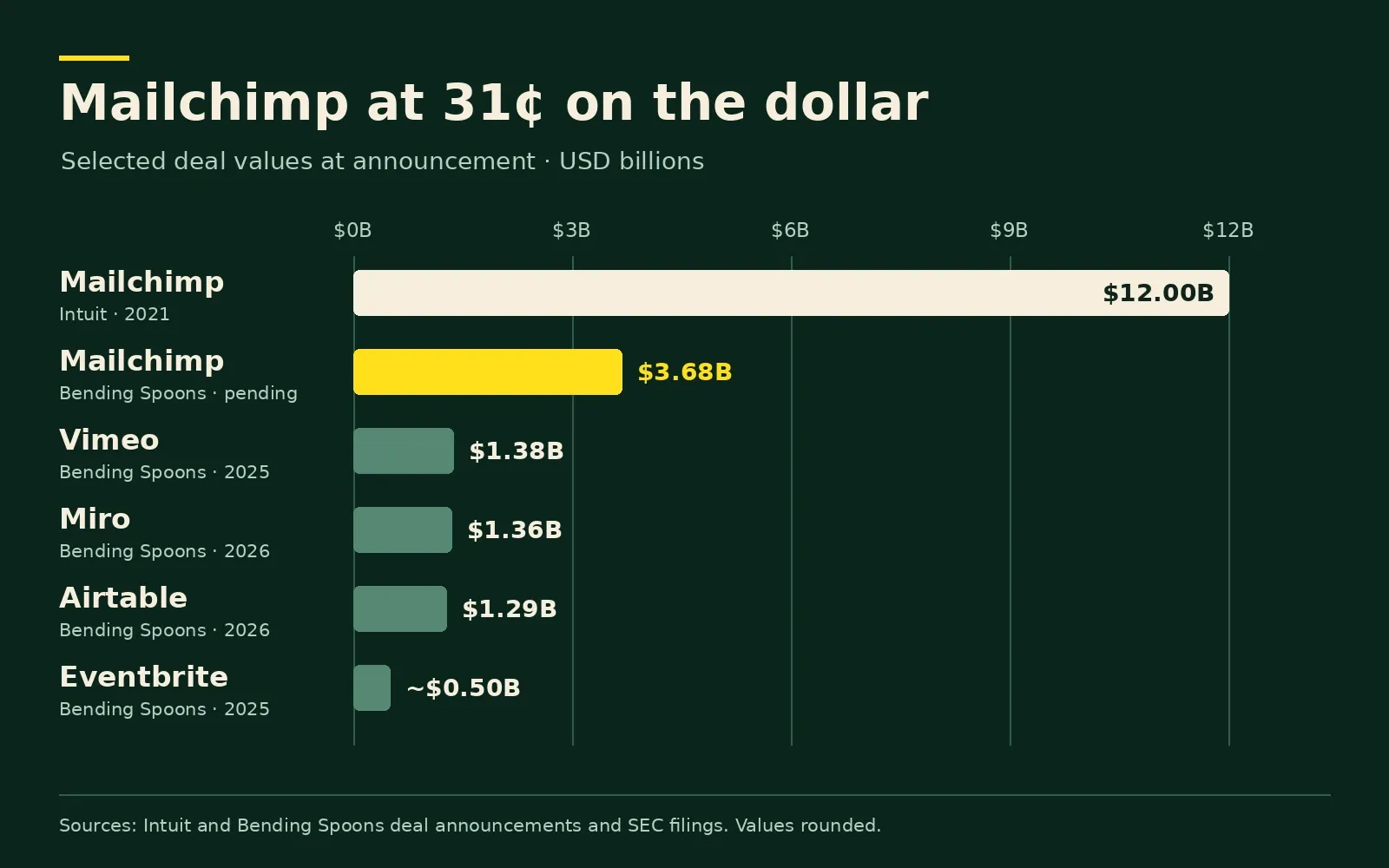
The headline numbers:
- Price: $3.68 billion, made up of $3.31 billion in cash and $368 million in Bending Spoons stock (Intuit’s 10-Q).
- Timing: The deal is expected to close in early 2027, subject to regulatory approvals and other customary closing conditions (Intuit’s 10-Q).
- Multiple: Roughly 2.9× annualized revenue, based on Mailchimp’s $313 million in quarterly revenue (Reuters).
- Trajectory: Mailchimp revenue fell 1% year over year to $313 million in Intuit’s fiscal first quarter (Reuters).
Intuit says selling Mailchimp will sharpen its focus on AI-powered tools for small businesses (Intuit’s earnings release). From a customer’s perspective, AI coding tools make it easier to build a replacement for the few features a business actually uses. And when renewal comes around, cheaper alternatives are already on the table. I used to be a Mailchimp power user, and even I found it lacking compared with other email marketing platforms.For Bending Spoons, Mailchimp would give it an email marketing foothold alongside several products already in a typical marketing stack.
So who is Bending Spoons?
Bending Spoons is a Milan-based software company founded in 2013 and led by CEO Luca Ferrari. The company started by building its own mobile apps and eventually made acquisitions the centre of its business (TechCrunch). How much better has that worked out? Let’s take a quick gander at the numbers.
- Revenue: $671 million in 2024 and $1.31 billion in 2025. The November outlook puts 2026 revenue at $3.07 billion to $3.09 billion, including contributions from Airtable and Miro. Mailchimp is still pending (IPO prospectus, Q3 results).
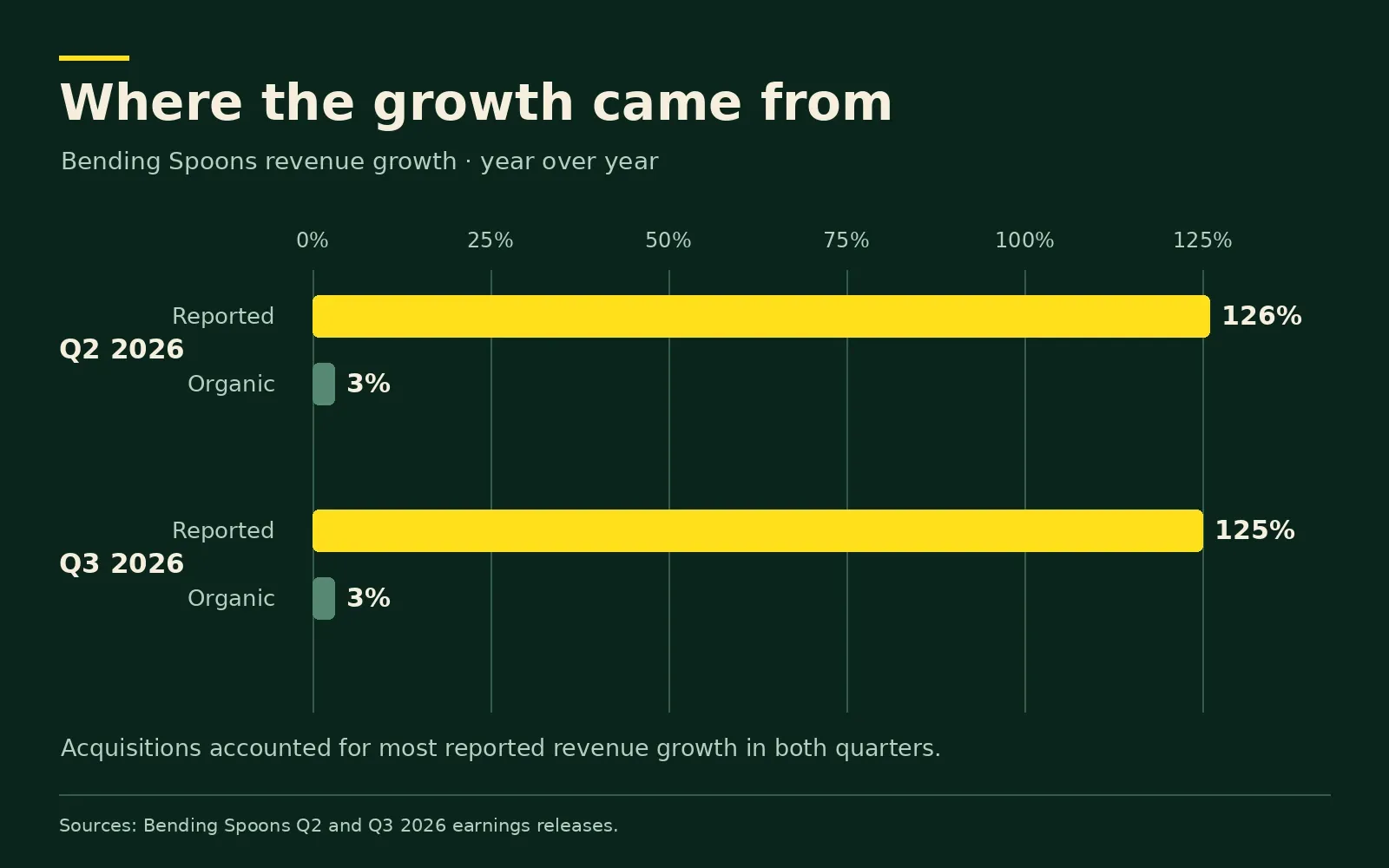
- Profitability: Q3 2026 revenue hit $780 million, up 125% year over year, with operating income at 22% of revenue (Q3 results).
- IPO: Bending Spoons listed on Nasdaq (BSP) on July 1, 2026, at $29 a share, with the company receiving $1.10 billion in net proceeds (IPO prospectus, Q2 results).
- Backers: Berkshire Hathaway invested $600 million at the IPO and another $330 million in October, bringing its ownership stake to 4% (Bending Spoons).
The Thanos-Style Acquisition Strategy
If I had to sum up Bending Spoons’ strategy in one sentence, it would be this: buy software that customers rely on, rebuild it on shared infrastructure with a leaner team, and charge more for it. Bending Spoons looks for products that are embedded in how companies work. It overhauls technology, reorganizes teams and ships new features, which can help justify higher prices (Bending Spoons’ results release). When the company announced the Brightcove deal, Ferrari explained how long it plans to hold those businesses.“When Bending Spoons acquires a business, we do so with the intention of owning and operating it indefinitely” (TVBEurope).
A Look at Bending Spoons’ Acquisitions
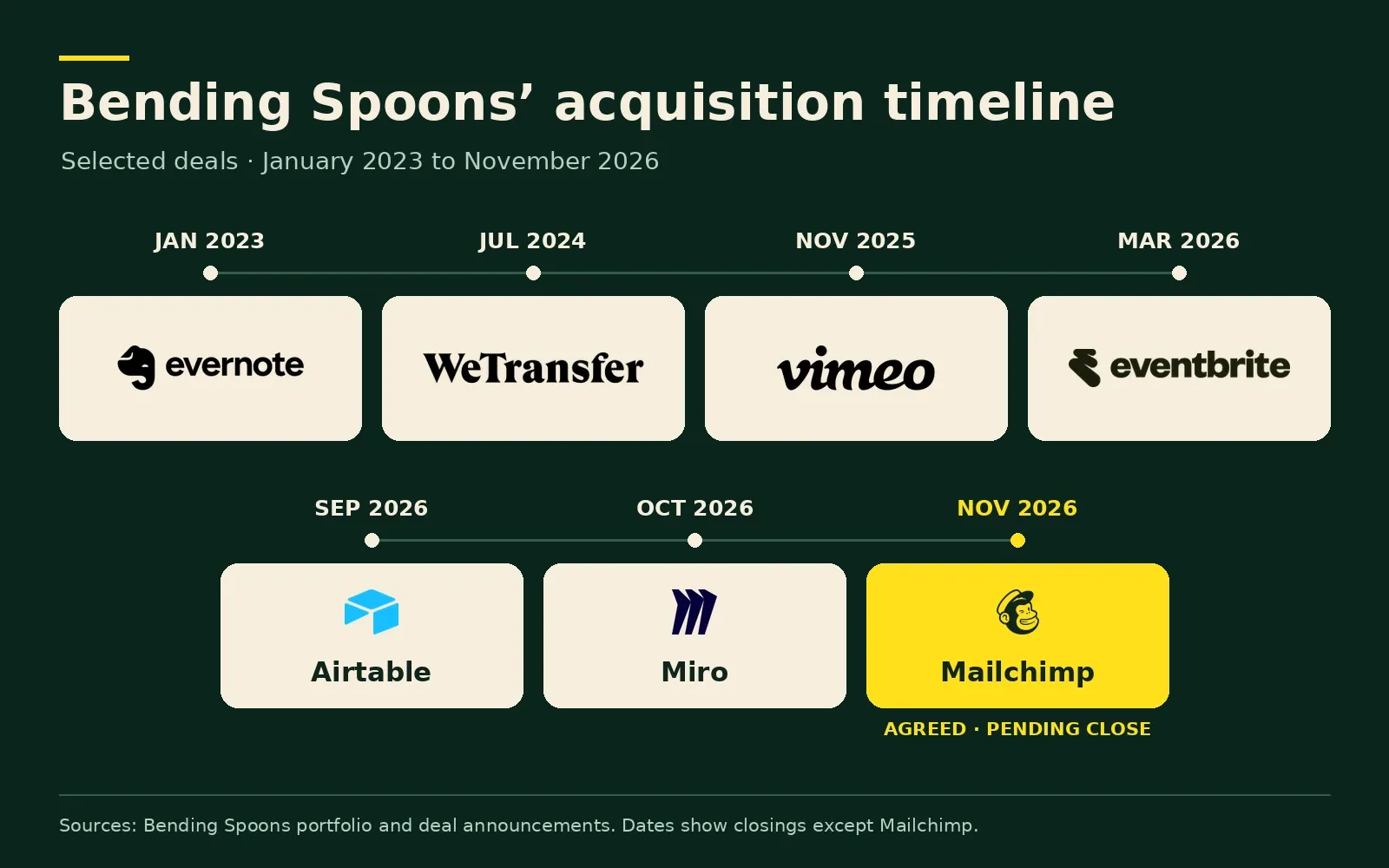
Chances are you or someone you know has used at least one of these products in the last few years (TechCrunch, Next Spoons, Bending Spoons).
| Category | Acquisitions | Biggest Price |
|---|---|---|
| SMB operations and marketing | Loomly (2025), Harvest (2025), MileIQ (2025), Mailchimp (pending, early 2027) | Mailchimp, $3.68B |
| Productivity and collaboration | Evernote (2023), Airtable (2026), Miro (2026) | Miro, $1.355B EV |
| Creative and video | Splice (2018), Remini (2021), FiLMiC (2022), Alight Motion (2023), StreamYard (2024), Brightcove (2025), Vimeo (2025) | Vimeo, $1.38B |
| Consumer utilities and lifestyle | Humamy (2023), Mosaic/Apalon apps incl. Clime, iTranslate, Robokiller (2024), komoot (2025), AOL (2025), Tractive (2026) | AOL, about $1.5B |
| Events and community | Meetup (2024), Eventbrite (2026) | Eventbrite, about $500M |
| File sharing and publishing | Issuu (2024), WeTransfer (2024) | Not disclosed |
I see four phases in the acquisition timeline.
- 2018 to 2022: the App Store years. Mobile photo and video apps such as Splice, Remini and FiLMiC earned revenue through app subscriptions (TechCrunch, Next Spoons).
- 2023 to 2024: the forgotten icons. Bending Spoons picked up Evernote, Meetup and WeTransfer, all recognizable names with established user bases (TechCrunch, Next Spoons).
- 2025: bigger deals. Brightcove, Vimeo and AOL brought larger businesses and nine- and ten-figure price tags (TVBEurope, TechCrunch, Next Spoons).
- 2026: the billion-dollar deals. Eventbrite and Tractive joined before the IPO. Airtable and Miro followed, and the pending Mailchimp deal would be the company’s third acquisition valued at more than $1 billion since listing (Next Spoons, Airtable announcement, Miro announcement, Mailchimp announcement).
The Acquisition Playbook
Once the sticker shock fades, five moves stand out.
- Focus on sticky products: Airtable, Miro and Mailchimp are easy to swap out on paper. It’s a different story when you have to migrate years of data and rebuild workflows that several teams depend on. That’s the appeal for Bending Spoons. At acquisition, the average paying Evernote customer had been paying for 7.2 years, according to the company’s SEC filing (GIGAZINE, citing Ars Technica). Co-founder Matteo Danieli has said retention across the portfolio has remained “remarkably stable” despite the changes (TechCrunch).
- Rebuild the infrastructure and consolidate teams: Bending Spoons uses shared technology and reorganizes teams as it integrates acquired businesses (Bending Spoons’ results release). The cuts can be steep. WeTransfer cut about 75% of its staff, komoot lost roughly three-quarters, and Vimeo reportedly lost most of its team (TechRadar, heise, PetaPixel).
- Customers pay the price, literally: Bending Spoons ran about 200 experiments on Evernote between 2023 and 2025, testing pricing, plans and features. By 2025, average revenue per monthly active user had risen to 2.5 times its 2022 level (GIGAZINE, citing Ars Technica). The Personal plan went from $70 to $130 a year within months of the deal, and the 2026 plan changes pushed some users to $250 (Ecosistema Startup, citing CNBC).
- Use free-tier limits to drive upgrades: In December 2023, free Evernote accounts were capped at 50 notes and one notebook. By 2025, 51% of new paid Evernote subscriptions started with a user hitting a usage limit. Limit-driven upgrades in 2024 ran at about double the 2022 level (GIGAZINE).
- Integrate for the long term: The more products use shared tools for payments, analytics and experimentation, the less work it should take to integrate the next one. Bending Spoons says it reinvests earnings from acquired businesses into new deals and has never sold a material business (Bending Spoons’ results release).
The receipts: what happens after the deal closes
So how does this feel from the employee or customer side? Not great, Bob.
| Product | What changed | Customer reaction |
|---|---|---|
| Harvest | Harvest replaced flat per-seat pricing with a base rate plus usage fees (Subscription Insider). | Some renewals rose by as much as 1,500%, and one freelancer’s plan jumped twelvefold to $2,547.60 (Bloomberg Government). |
| Evernote | Evernote raised prices repeatedly, capped the free tier at 50 notes and reshuffled plans in 2026 (TechCrunch, Ecosistema Startup). | Customers posted negative reviews, while Bending Spoons said retention remained steady (TechCrunch). |
| WeTransfer | WeTransfer cut about 75% of its staff (TechRadar). A July 2025 terms update mentioned machine learning (PPC Land). | After creators pushed back, WeTransfer revised the terms within days (NationalWorld). |
| Vimeo | Vimeo cut staff following the acquisition, and former employees said almost everyone was gone (TechCrunch, PetaPixel). | Video-hosting competitor Gumlet said Vimeo customers were exploring alternatives (Gumlet via AB Newswire). |
| Eventbrite | Eventbrite cut staff in April 2026, rolled out product updates and moved some marketing tools to a paid tier (Reuters via WHBL). | Eventbrite kept per-ticket fees steady in 2026 (TickPick). |
| komoot | Staff reported little warning before the sale, and roughly three-quarters were laid off (road.cc, heise). | Some users felt the sale betrayed a community that had helped build the product (Bikepacking.com). |
The shared infrastructure and smaller teams make it cheaper to run these products. Higher prices can help Bending Spoons recoup what it paid. But I see two pressure points.
- The pricing squeeze may have a ceiling: Organic revenue grew 3% in each of Q2 and Q3 2026, and acquisitions accounted for most of the reported revenue growth in both quarters (Q2 results, Q3 results). I’ll be watching whether Harvest, Miro, Airtable and eventually Mailchimp can grow on their own after integration.
- AI is making some tools easier to replace: I’ve seen a few examples of people building their own software when the subscription gets too expensive.
- Marc Lou, an indie developer, started building an open-source beehiiv alternative using Amazon SES after his annual bill jumped from $1,000 to $4,000 (Marc Lou on X).
- He launched it as MailCheap, which he pitched as 83% cheaper than beehiiv and able to import from beehiiv, Substack or Mailchimp in two minutes (Marc Lou on X, Axel Schapmann).
- AppSumo CEO Noah Kagan shared that someone on his team was building a task manager to replace a $4,800 annual Asana bill.
- One web developer told Bloomberg he used Claude Code to rebuild the Harvest features he needed inside his own app (Silicon UK, citing Bloomberg).
- Marc Lou, an indie developer, started building an open-source beehiiv alternative using Amazon SES after his annual bill jumped from $1,000 to $4,000 (Marc Lou on X).
Even yours truly has built a project management system, a budgeting app and a few other tools. If more customers can build what they need with Claude Code, Codex or Cursor, Bending Spoons may have less room to raise prices than it expects.
What happens to Mailchimp now
Intuit had already pulled a few of the same levers.
- June 2025: Mailchimp retired the Classic Automation Builder. Its replacement was available on the Standard plan and above (EmailOctopus).
- January 2026: The free plan shrank from 500 contacts and 1,000 sends to 250 contacts and 500 sends (Benchmark Email).
- April 2026: Users on pre-2019 legacy plans reportedly saw average price increases of 11% to 13% (ActiveCampaign).
Here’s what I expect in the first 18 months after the deal closes.
- Bending Spoons will cut more than half of Mailchimp’s staff. The figure could reach 75% if the integration follows the WeTransfer pattern.
- Pricing will lean more heavily on usage. Mailchimp already uses contacts, email sends, and automation features to differentiate plans. If Bending Spoons follows Harvest’s base-plus-usage model, customers with large lists could feel it hardest, especially during peak sending seasons.
- A shorter free trial. I expect the 14-day trial to drop to as little as seven days.
- Visible product improvements within six months. Eventbrite got faster event creation, better images and offline tickets within weeks of its takeover (Reuters via WHBL). I expect Mailchimp to improve speed and reliability to keep long-time customers.
- Bonus prediction: Bending Spoons will sell a small-business suite. It already has a foothold in several parts of the stack and would add email marketing if the deal closes. There’s room to cross-sell and connect these products to tools like Claude and Codex through MCP and APIs.
- Time tracking and invoice management (Harvest)
- Operations and project management (Airtable)
- Product management and DevOps (Miro)
- Email marketing (Mailchimp, pending)
- Social media (Loomly)
What to do if you're a Mailchimp customer
- Clean your list regularly. Remove inactive subscribers from your active mailing list. Keep a separate, up-to-date export of unsubscribed and suppressed contacts so you can carry those exclusions over if you switch platforms. Set up the exclusions in your new platform before sending your first campaign.
- Export what you can and keep it current. Back up your audiences, templates and performance data, and document your automation logic. It’s easier to do this now than on a deadline if you decide to move platforms.
- Know your renewal date. Check your billing terms and watch for pricing notices before your next payment.
- Don’t panic-migrate. The product could improve before it gets more expensive. Price out alternatives now so you have a basis for deciding when the next pricing update lands.
Who's next: five predictions
Bending Spoons’ co-founder in charge of acquisitions says the pipeline “remains strong” (Barchart via Webull). So let’s play fantasy M&A. Here’s what I’m looking for.
- A large, long-standing user base that would hate to migrate.
- Stalled growth and a valuation well below its peak.
- Pricing headroom, usually a generous free tier or underpriced legacy plans.
- A portfolio fit, ideally filling a gap next to Mailchimp, Eventbrite, Airtable and friends.
You can also play a Tinder-style game at Next Spoons to see who others predict as the next target.
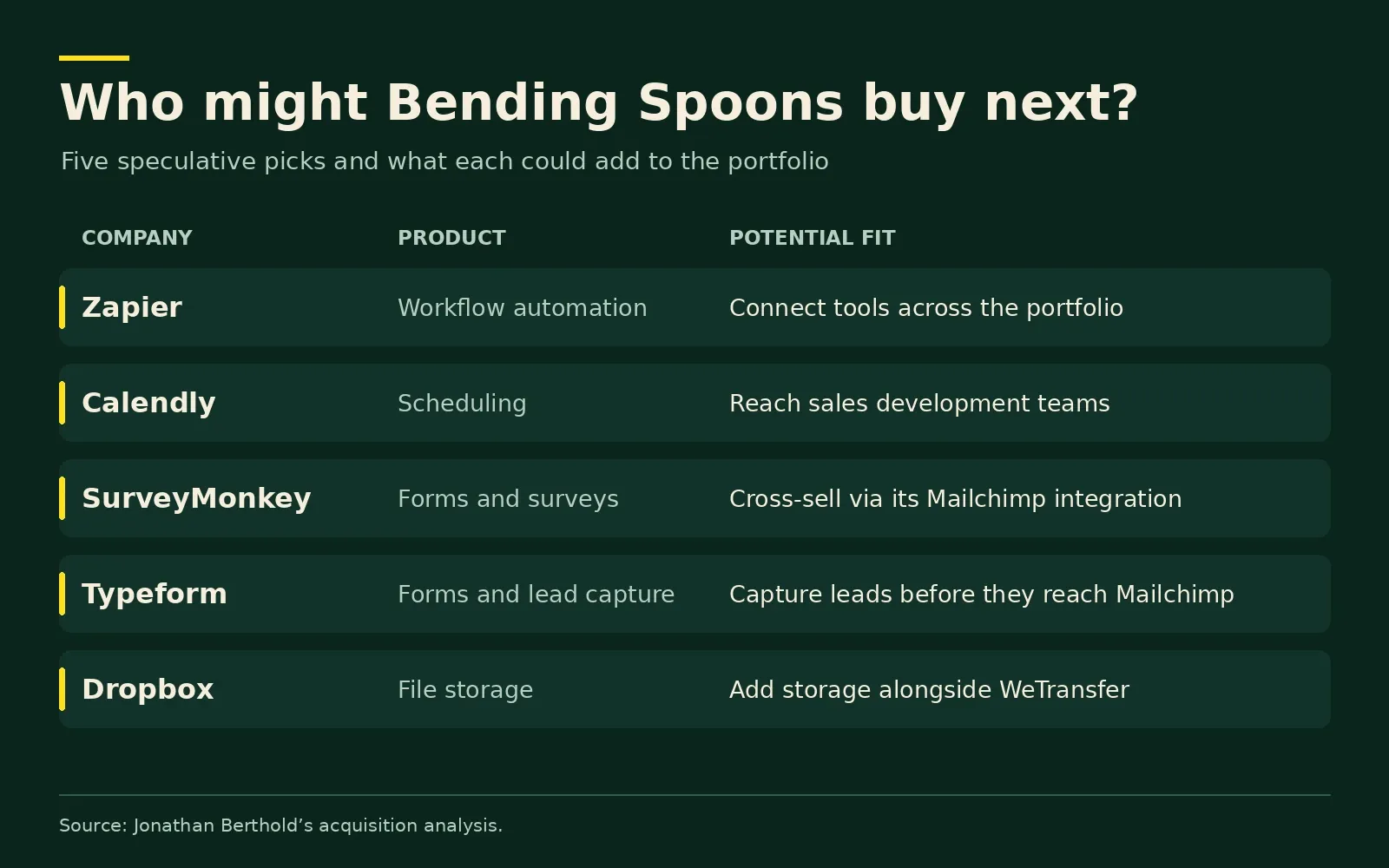
- Zapier (workflow automation). Zapier reached a $5 billion valuation in 2021 on about $1.4 million in funding (Sacra). CEO Wade Foster put annual recurring revenue in the hundreds of millions (Madrona). Zapier’s core business is workflow automation, and coding tools like Claude and Codex give some customers another way to build those workflows.
- Calendly (scheduling). Valued at more than $3 billion in 2021 (TechCrunch), Calendly could give Bending Spoons a foothold with sales development teams that use it to book meetings.
- SurveyMonkey (forms and surveys). Three years into a private equity hold after a $1.5 billion take-private deal, with roughly $481 million in revenue (Seedtable, Dealroom). Its existing Mailchimp integration gives Bending Spoons a natural place to cross-sell to customers using either product.
- Typeform (forms and lead capture). Typeform was valued at $935 million in its March 2022 funding round (TechCrunch). It would let Bending Spoons capture leads before they reach Mailchimp.
- Dropbox (file storage, aka the whale). Dropbox ended fiscal 2025 with 18.08 million paying users. Revenue fell 1.1% to $2.52 billion, while free cash flow rose to $931 million (Dropbox). It’s a much bigger bet than WeTransfer, but the overlap in file sharing is why I’d keep it on the list.
Wildcard: Wix. Its shares fell 56% in the first half of 2026 (Nasdaq). A website builder could be the front door for small businesses using the rest of the portfolio, though the overlap alone may not make the deal attractive.
Let's see how this plays out.
The Mailchimp deal is expected to close in early 2027 (Intuit’s 10-Q). Here’s what I’ll be watching once the ink dries.
- The first pricing update email: If Mailchimp’s next pricing update hits as hard as Harvest’s did, we’ll see how much longtime customers are willing to pay to avoid moving.
- The first product release: Eventbrite shipped visible improvements within weeks (Reuters via WHBL). Mailchimp has more moving pieces, including contact permissions and sending compliance. I’ll be watching which customer problems Bending Spoons tackles first.
- The next deal: My hunch is we’ll see a few acquisitions in Q1 2027, with one surpassing Mailchimp’s price.
So far, Bending Spoons has bet that customers will pay more to keep using software they already depend on. Mailchimp will test that bet as AI coding tools make it easier for some of those customers to build what they need themselves.